
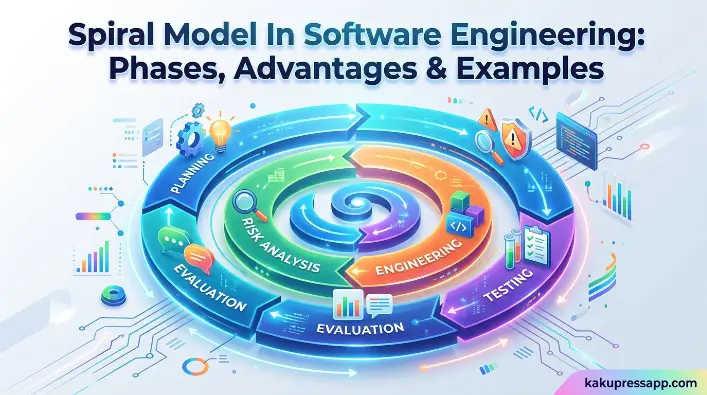
Welcome to kaku press app. The spiral model in software engineering is one of the most effective Software Development Life Cycle (SDLC) models for managing large, complex, and high-risk software projects. Unlike traditional development approaches, it combines iterative development with comprehensive risk analysis, enabling development teams to identify, evaluate, and resolve potential issues early in the software development process. This proactive approach minimizes project risks, improves software quality, and makes it an ideal choice for enterprise-level applications where reliability, scalability, and flexibility are critical.
Introduced by Barry Boehm in 1986, the spiral model in software engineering emphasizes continuous improvement through a series of iterative development cycles, known as spirals. Each iteration consists of four key phases: planning, risk analysis, engineering, and customer evaluation. By incorporating regular stakeholder feedback and thorough risk assessment into every cycle, the model ensures that the software evolves according to changing business requirements and user expectations. In this comprehensive guide, you’ll explore how the spiral model in software engineering works, its core phases, advantages, disadvantages, real-world applications, and the scenarios where it delivers the best results.
What Is Spiral Model in Software Engineering?
The spiral model in software engineering is a risk-driven Software Development Life Cycle (SDLC) model that combines the structured nature of the Waterfall Model with the flexibility of iterative development. Instead of completing the project in a single sequence, development progresses through multiple iterations called spirals. Each spiral adds new functionality while reducing project risks. This model is particularly valuable for projects where requirements are expected to change or where technical uncertainty exists. Before moving to the next phase, the development team carefully analyzes possible risks and plans strategies to minimize them.
Why Is It Called the Spiral Model?
The model is represented by a spiral-shaped diagram where each loop corresponds to one iteration of the development process. As the project progresses, the spiral expands outward, indicating increased functionality and project maturity. Because risk management is the central focus, organizations developing mission-critical software frequently choose the spiral model in software engineering over simpler SDLC models.
Each loop includes four major activities:
- Planning
- Risk Analysis
- Engineering
- Evaluation
Every new spiral builds upon the results of the previous one, ensuring continuous refinement and improvement.
History of the Spiral Model
The spiral model in software engineering was introduced by Barry Boehm in 1986 to overcome the limitations of traditional software development approaches. During that time, many software projects experienced delays, budget overruns, and failures because potential risks were often identified too late in the development process. To solve this challenge, Boehm designed a risk-driven development model that integrates risk assessment into every stage of the Software Development Life Cycle (SDLC).
One of the defining features of the spiral model in software engineering is its strong emphasis on risk management. Instead of following a rigid, linear process, the model allows development teams to identify, analyze, and mitigate potential risks during each iteration before moving to the next phase. This proactive approach significantly reduces the chances of project failure while improving software quality and overall project success.
How the Spiral Model in Software Engineering Works
The spiral model in software engineering follows an iterative and risk-driven development approach, where software is built through a series of repeated cycles, known as spirals. Rather than developing the entire application in a single sequence, the project is divided into multiple iterations. Each iteration adds new features, enhances existing functionality, and resolves issues identified in previous cycles, resulting in a more refined and reliable product over time.
Every iteration begins by defining project objectives, gathering requirements, and planning the work to be completed. The development team then performs a detailed risk analysis to identify potential technical, financial, or operational challenges before moving forward. After evaluating the risks, developers design, build, and test the software increment, ensuring it meets both functional and quality requirements.
Iterative Development Process
The development process starts with basic project planning and gradually adds features over multiple iterations. Every spiral produces an improved version of the software, enabling developers to detect defects early rather than waiting until the end of the project. Developers design, build, test, and evaluate each software increment before starting the next iteration.
Benefits of iterative development include:
- Faster identification of issues
- Better adaptability to requirement changes
- Improved software quality
- Reduced development risks
- Continuous delivery of improved versions
Importance of Risk Analysis
Risk analysis is the defining feature of the spiral model in software engineering. Before significant resources are invested, the development team evaluates technical, financial, operational, and scheduling risks.Developers design, build, test, and evaluate each software increment before starting the next iteration. This process enables teams to identify and fix defects early, incorporate stakeholder feedback, and make improvements throughout the development. Examples of common project risks include:
- Changing customer requirements
- Technology limitations
- Budget overruns
- Integration challenges
- Performance issues
- Security vulnerabilities
By identifying these risks early, teams can develop mitigation strategies that prevent costly project failures.
Customer Feedback
Unlike linear SDLC models, the spiral model in software engineering encourages customer involvement throughout the project. After every iteration, stakeholders review the software prototype or completed functionality and provide suggestions for improvement. This feedback helps ensure the final product closely matches user expectations and business objectives.
Benefits include:
- Improved customer satisfaction
- Reduced misunderstanding of requirements
- Early validation of features
- Higher project success rates
Continuous Improvement
The development process in the spiral model in software engineering begins with careful project planning, where the development team identifies project objectives, gathers requirements, estimates resources, and defines the scope of the current iteration. Rather than attempting to build the entire software application in a single development cycle, the project is divided into multiple spirals. Each spiral focuses on delivering a specific set of features while addressing potential risks before moving to the next stage. This iterative approach provides greater flexibility and allows the software to evolve gradually based on project needs.
With every completed spiral, the software becomes more refined and feature-rich. Developers design, build, test, and evaluate each software increment before starting the next iteration. This process enables teams to identify and fix defects early, incorporate stakeholder feedback, and make improvements throughout the development lifecycle instead of waiting until the project’s final phase. As a result, the spiral model in software engineering helps improve software quality, reduce development risks, and deliver a product that better meets customer requirements.
Read Also: Waterfall Model in Software Engineering: Complete SDLC Guide
Four Phases of Spiral Model in Software Engineering
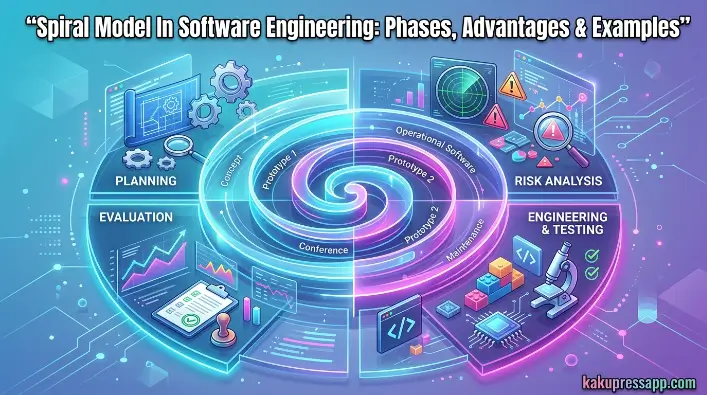
Every iteration of the spiral model in software engineering consists of four essential phases. These phases repeat until the software product is complete, with each cycle producing a more refined and feature-rich version of the system. This process enables teams to identify and fix defects early, incorporate stakeholder feedback, and make improvements throughout the development lifecycle instead of waiting until the project’s final phase. As a result, the spiral model in software engineering helps improve software quality, reduce development risks, and deliver a product that better meets customer requirements.
| Phase | Primary Objective | Key Output |
| Planning | Define objectives and requirements | Project plan |
| Risk Analysis | Identify and reduce risks | Risk mitigation strategy |
| Engineering | Design, develop, and test | Working software increment |
| Evaluation | Gather stakeholder feedback | Approved improvements |
Phase 1 – Planning
Planning is the foundation of every spiral. During this phase, project managers, developers, and stakeholders determine the objectives for the upcoming iteration. This process enables teams to identify and fix defects early, incorporate stakeholder feedback, and make improvements throughout the development lifecycle instead of waiting until the project’s final phase. As a result, the spiral model in software engineering helps improve software quality, reduce development risks, and deliver a product that better meets customer requirements.
- Collect business requirements
- Define project scope
- Estimate cost and schedule
- Allocate resources
- Set development goals
- Prioritize features
- Requirement specification
- Development roadmap
- Budget estimates
- Resource allocation plan
- Project schedule
Phase 2 – Risk Analysis
Risk analysis is the most critical stage of the spiral model in software engineering. The development team identifies potential challenges that could affect the success of the project. Instead of ignoring uncertainties, the team evaluates each risk and develops strategies to reduce or eliminate it. This process enables teams to identify and fix defects early, incorporate stakeholder feedback, and make improvements throughout the development lifecycle instead of waiting until the project’s final phase. As a result, the spiral model in software engineering helps improve software quality, reduce development risks, and deliver a product that better meets customer requirements.
- Identify technical risks
- Analyze financial risks
- Evaluate security threats
- Assess performance concerns
- Review alternative solutions
- Create prototypes if necessary
- Risk assessment report
- Risk mitigation plan
- Feasibility analysis
- Prototype (if required)
Phase 3 – Engineering (Development & Testing)
Once risks have been addressed, the project moves to the engineering phase. Here, developers transform the approved design into working software. This process enables teams to identify and fix defects early, incorporate stakeholder feedback, and make improvements throughout the development lifecycle instead of waiting until the project’s final phase. As a result, the spiral model in software engineering helps improve software quality, reduce development risks, and deliver a product that better meets customer requirements. Coding, integration, testing, and quality assurance all occur during this stage.
- Software design
- Coding
- Database development
- Unit testing
- Integration testing
- System testing
- Bug fixing
- Functional software module
- Test reports
- Updated documentation
- Verified software increment
Phase 4 – Evaluation
The evaluation phase ensures the developed software meets user expectations before the next iteration begins. This process enables teams to identify and fix defects early, incorporate stakeholder feedback, and make improvements throughout the development lifecycle instead of waiting until the project’s final phase. As a result, the spiral model in software engineering helps improve software quality, reduce development risks, and deliver a product that better meets customer requirements. Customers, stakeholders, and project managers review the completed work and provide valuable feedback.
- Demonstrate completed features
- Collect stakeholder feedback
- Validate business requirements
- Identify improvements
- Approve the next iteration
- Customer feedback report
- Approved software increment
- Updated project requirements
- Plan for the next spiral
How the Four Phases Work Together
The four phases form a continuous improvement cycle. Instead of considering the project complete after one pass, the team repeats the process until all business objectives have been achieved. The evaluation phase ensures the developed software meets user expectations before the next iteration begins. This process enables teams to identify and fix defects early, incorporate stakeholder feedback, and make improvements throughout the development lifecycle instead of waiting until the project’s final phase.
The workflow follows this sequence:
- Planning – Define objectives and gather requirements.
- Risk Analysis – Identify and mitigate potential risks.
- Engineering – Develop, test, and integrate the software.
- Evaluation – Collect feedback and prepare for the next iteration.
By repeating these steps, the spiral model in software engineering enables organizations to produce high-quality software while effectively managing uncertainty and accommodating evolving customer needs.
When Should You Use Spiral Model in Software Engineering?
The spiral model in software engineering is best suited for projects that involve significant complexity, evolving requirements, or high levels of risk. Its iterative and risk-driven approach enables development teams to identify potential issues early while continuously improving the software through customer feedback. Although it may not be the ideal choice for every project, it offers exceptional benefits when flexibility, quality, and risk management are top priorities. Organizations typically choose the spiral model in software engineering for projects where requirements are not fully defined at the beginning or are expected to change throughout development. Since every iteration includes planning, risk analysis, development, testing, and evaluation, teams can easily adapt to new business needs without restarting the entire project.
- Large-scale enterprise software
- Banking and financial systems
- Healthcare and hospital management applications
- Defense and military software
- Aerospace and aviation systems
- Artificial Intelligence (AI) and Machine Learning projects
- Government and public sector applications
- Research and development projects
- Complex web and cloud-based applications
- Small software projects
- Simple websites
- Low-budget applications
- Projects with fixed and well-defined requirements
- Short-term development projects
Spiral Model in Software Engineering vs Waterfall Model vs Agile
Choosing the right SDLC model depends on the project’s size, complexity, budget, and requirements. The spiral model in software engineering, the Waterfall Model, and the Agile Model each have unique strengths and are suitable for different scenarios.
| Feature | Spiral Model | Waterfall Model | Agile Model |
| Development Style | Iterative and Risk-Driven | Sequential | Iterative and Incremental |
| Risk Management | Excellent | Limited | Good |
| Customer Involvement | High | Low | Very High |
| Flexibility | High | Low | Very High |
| Requirement Changes | Easily Managed | Difficult | Easily Managed |
| Testing | Every Iteration | End of Project | Continuous |
| Cost | High | Low | Moderate |
| Best For | Large, High-Risk Projects | Small Projects with Fixed Requirements | Fast-Changing Projects |
Common Mistakes When Using Spiral Model in Software Engineering
While the spiral model in software engineering offers many benefits, its effectiveness depends on proper implementation. Avoiding common mistakes can significantly improve project success. If your project is large, complex, and involves significant technical or business risks, the spiral model in software engineering is often the best option because it emphasizes risk management and continuous improvement. If the project has stable requirements and follows a straightforward process, the Waterfall Model may be sufficient. For projects requiring rapid development, frequent releases, and continuous customer collaboration, Agile is usually the preferred choice.
Ignoring Risk Analysis
One of the most common mistakes when implementing the spiral model in software engineering is rushing into development without conducting a detailed risk assessment. Risk analysis is the foundation of this SDLC model, as it helps identify potential technical, financial, operational, and security challenges before development begins. Ignoring this crucial step can leave the project vulnerable to unexpected problems, making it difficult to manage changes and increasing the likelihood of costly errors.
A thorough risk assessment enables development teams to prepare effective mitigation strategies and make informed decisions at every iteration. By identifying risks early, teams can avoid project delays, budget overruns, performance issues, and software failures. Following a structured risk management process ensures that the spiral model in software engineering delivers high-quality, reliable software while reducing uncertainty and improving the overall success of the project.
Poor Stakeholder Communication
Regular customer feedback is a key component of the spiral model in software engineering because it ensures that the software is developed according to user needs and business objectives. After each iteration, stakeholders review the completed features, provide suggestions, and identify any necessary improvements. This continuous collaboration helps the development team validate requirements, resolve misunderstandings early, and ensure the project stays aligned with its goals.
Without active stakeholder involvement, developers may build features that fail to meet business requirements or customer expectations. This can lead to costly rework, project delays, and reduced user satisfaction. By encouraging consistent communication and feedback throughout the development lifecycle, the spiral model in software engineering enables teams to make informed decisions, improve software quality, and deliver a final product that effectively meets both business and user needs.
Inadequate Planning
Weak planning is one of the most common reasons software projects fail when using the spiral model in software engineering. Without a well-defined plan, development teams may face unrealistic schedules, budget overruns, unclear project scope, and resource shortages. Poor planning can also create confusion among team members, making it difficult to prioritize tasks and achieve project objectives within the expected timeline.
To avoid these challenges, every iteration in the spiral model in software engineering should begin with clearly defined objectives, deliverables, timelines, and resource allocation. A structured planning process helps the team understand project requirements, estimate costs accurately, and set realistic milestones for each development cycle. Effective planning not only improves project management but also ensures smoother execution, better coordination, and a higher likelihood of delivering high-quality software on time and within budget.
Insufficient Documentation
Although the spiral model in software engineering follows an iterative development approach, maintaining proper documentation remains essential throughout the project lifecycle. Each iteration generates new requirements, design updates, risk assessments, testing results, and stakeholder feedback that must be accurately documented. Well-organized documentation helps development teams understand project objectives, track progress, and maintain consistency across all development cycles.
Clear and comprehensive documentation also simplifies future software maintenance, troubleshooting, and system upgrades. It provides a reliable reference for developers, testers, project managers, and other stakeholders, reducing misunderstandings and improving collaboration. By keeping documentation up to date after every iteration, organizations using the spiral model in software engineering can ensure better project management, easier knowledge transfer, and a more efficient software development process.
Delaying Testing
Continuous testing is a crucial practice in the spiral model in software engineering because it ensures that each software increment is thoroughly verified before moving to the next iteration. Instead of postponing testing until the entire project is completed, developers and quality assurance teams test every new feature as it is developed. This approach helps identify defects, performance issues, and security vulnerabilities at an early stage, making them easier and less expensive to fix.
Delaying testing until the final phase can lead to the accumulation of bugs, increased development costs, and project delays. By performing testing during every iteration, teams can validate functionality, ensure that requirements are met, and maintain consistent software quality throughout the development lifecycle. Regular testing also supports continuous improvement, allowing the spiral model in software engineering to deliver reliable, high-quality software that meets both business objectives and user expectations.
Best Practices for Spiral Model in Software Engineering
Following best practices helps organizations maximize the benefits of the spiral model in software engineering while minimizing development risks. Delaying testing until the final phase can lead to the accumulation of bugs, increased development costs, and project delays. By performing testing during every iteration, teams can validate functionality, ensure that requirements are met, and maintain consistent software quality throughout the development lifecycle.
- Conduct a comprehensive risk assessment before every iteration.
- Involve stakeholders throughout the development process.
- Build prototypes for uncertain or high-risk features.
- Perform continuous testing and quality assurance.
- Maintain detailed project documentation.
- Review project progress after every spiral.
- Prioritize high-risk requirements in the early iterations.
- Encourage collaboration between developers, testers, and business stakeholders.
- Monitor project costs and timelines regularly.
- Continuously improve the software based on customer feedback.
Implementing these practices ensures smoother project execution, better software quality, and higher customer satisfaction.
Frequently Asked Questions
What is Spiral Model in Software Engineering?
The spiral model in software engineering is a risk-driven Software Development Life Cycle (SDLC) model that combines iterative development with systematic risk analysis. It enables development teams to build software through multiple iterations while continuously identifying and managing project risks.
Who invented the Spiral Model in Software Engineering?
The spiral model in software engineering was developed by Barry Boehm in 1986. He introduced this model to overcome the limitations of traditional software development approaches by making risk management a key part of every development cycle.
What are the four phases of the Spiral Model in Software Engineering?
Some teams rush into development without performing a detailed risk assessment. Since risk management is the foundation of the Spiral Model, skipping this step can lead to costly project failures.
What are the main advantages of the Spiral Model in Software Engineering?
Although the model is iterative, maintaining proper documentation is still important. Clear documentation helps development teams track progress, understand requirements, and support future maintenance.
When should you use the Spiral Model in Software Engineering?
The spiral model in software engineering should be used for large, complex, and high-risk software projects where requirements are expected to change over time. It is commonly used in banking, healthcare, aerospace, defense, and enterprise software development.
Conclusion
The spiral model in software engineering is one of the most reliable and flexible Software Development Life Cycle (SDLC) models for managing complex and high-risk software projects. By combining iterative development with continuous risk analysis, it enables organizations to identify potential challenges early, improve software quality, and adapt to changing business requirements throughout the project lifecycle.
Although the spiral model in software engineering requires experienced project management, additional resources, and higher development costs, its advantages often outweigh these challenges for mission-critical applications. Organizations that prioritize risk management, customer collaboration, and continuous improvement can benefit greatly from adopting this model. Choosing the right SDLC approach ultimately depends on your project’s goals, complexity, and budget, but for large-scale and risk-sensitive projects, the Spiral Model remains one of the strongest and most effective development methodologies.
