
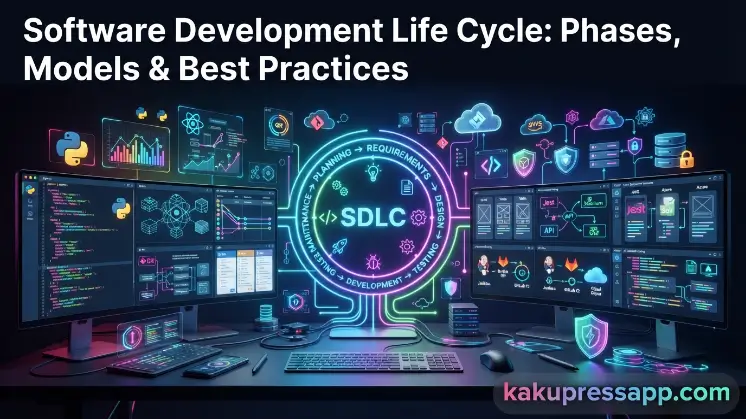
Welcome to kaku press app. Modern software applications are built through a structured process that helps teams transform ideas into reliable digital products. The software development life cycle (SDLC) provides a systematic framework that guides developers, project managers, testers, and stakeholders through every stage of software creation, from initial planning to long-term maintenance.Whether a company is developing a mobile application, enterprise software, or a cloud-based platform, following an effective software development life cycle helps reduce risks, improve quality, control costs, and deliver better solutions.
Without a proper development process, projects often face delays, security issues, and unexpected failures.In this complete guide, we will explore the different phases of SDLC, popular SDLC models, benefits, challenges, best practices, and modern approaches such as Agile, DevOps, and Secure SDLC. Understanding these concepts can help businesses and development teams build software more efficiently and successfully.
Software Development Life Cycle: Phases, Models & Best Practices
The software development life cycle (SDLC) is a structured approach used by software teams to design, develop, test, deploy, and maintain software applications. It provides a clear roadmap that helps organizations build reliable software while managing time, costs, resources, and risks effectively.From small mobile applications to complex enterprise platforms, the software development life cycle ensures that every stage of software creation follows a planned process. By using SDLC methodologies, development teams can improve software quality, reduce errors, and deliver solutions that meet user and business requirements.
What Is the Software Development Life Cycle (SDLC)?
The software development life cycle is a structured process used by software development teams to design, develop, test, deploy, and maintain software applications. It defines a series of steps that help teams manage the entire software development process from the initial idea to the final product.SDLC is not just a coding process. It includes planning, requirement analysis, system design, programming, quality assurance, deployment, and continuous improvement. Each phase has specific goals, activities, and deliverables that contribute to creating reliable and scalable software.
A well-defined SDLC process ensures that every team member understands their responsibilities and that the project follows a predictable path. It also allows organizations to identify problems early, improve collaboration, and make informed decisions throughout development.By using SDLC methodologies, development teams can improve software quality, reduce errors, and deliver solutions that meet user and business requirements.
Definition of SDLC
SDLC stands for Software Development Life Cycle. It is a methodology that describes how software is planned, created, tested, released, and maintained.The main purpose of SDLC is to provide a clear roadmap for developing software while ensuring:By using SDLC methodologies, development teams can improve software quality, reduce errors, and deliver solutions that meet user and business requirements.
- High-quality software delivery
- Better project management
- Reduced development risks
- Improved security
- Efficient use of resources
Instead of building software randomly, teams follow defined stages that help them achieve business and technical objectives.
For example, before developers start writing code for an online shopping application, the team first identifies customer requirements, designs the system architecture, creates development plans, tests features, and prepares the application for launch. This complete journey represents the software development life cycle.
Why Is SDLC Important in Software Development?
The software development process can become complicated when multiple developers, designers, testers, and business teams are involved. SDLC creates organization and consistency by providing a clear development framework.Some major reasons why SDLC is important include.
Another major benefit of SDLC is that it improves software quality while reducing risks, time, and costs. By including proper planning, testing, and review stages, teams can identify errors early, prevent security issues, and deliver reliable software that meets user expectations. A well-managed SDLC process also improves communication between teams and helps organizations create scalable, maintainable, and successful software products.
How SDLC Works
The software development life cycle works by dividing software creation into different stages. Each stage produces specific outputs that become the foundation for the next phase.Although different organizations may customize these steps based on their needs, the core objective remains the same: creating reliable software through a controlled and efficient process.
The typical SDLC workflow includes:
- Planning
- Requirements analysis
- Software design
- Development
- Testing
- Deployment
- Maintenance
Although different organizations may customize these steps based on their needs, the core objective remains the same: creating reliable software through a controlled and efficient process.
The 7 Phases of the Software Development Life Cycle
The software development life cycle process consists of seven major phases that guide a project from the initial idea to a complete and functional software product. Each phase has a specific purpose, helping teams plan, design, develop, test, deploy, and maintain software in a structured way. Following these phases ensures that every important aspect of software development is properly managed. These SDLC phases help organizations reduce risks, improve software quality, and deliver solutions that meet user and business requirements.
Phase 1: Planning and Feasibility Analysis
The planning phase is the foundation of the entire software development process. During this stage, teams define project goals, analyze requirements, estimate resources, and determine whether the project is technically and financially possible.A successful planning phase helps prevent future problems by creating a clear project roadmap.
- Defining project objectives
- Identifying target users
- Estimating budget requirements
- Creating project timelines
- Selecting development technologies
- Evaluating possible risks
Teams also perform a feasibility analysis to determine whether the project can realistically be completed.
Phase 2: Requirements Gathering and Analysis
The requirements analysis phase focuses on understanding what users and businesses need from the software.During this stage, developers, analysts, and stakeholders collect detailed information about software functionality, performance expectations, and business goals.The output of this phase is usually a Software Requirements Specification (SRS) document.
The foundation for the next phase.Although different organizations may customize these steps based on their needs, the core objective remains the same: creating reliable software through a controlled and efficient process.Teams also perform a feasibility analysis to determine whether the project can realistically be completed.
Read Also: software developer
Agile SDLC Model
The Agile SDLC model is one of the most widely used approaches in modern software development. Unlike traditional models, Agile focuses on flexibility, continuous improvement, and frequent collaboration between developers, customers, and stakeholders.Instead of delivering the complete product at the end of development, Agile teams release software in small increments called iterations or sprints.
Each sprint usually includes:
- Planning
- Development
- Testing
- Review
- Feedback
This approach allows teams to quickly adapt to changing requirements and customer expectations.
Key Principles of Agile SDLC
Agile development follows important principles that focus on flexibility, teamwork, and continuous improvement. Instead of following a fixed plan from start to finish, Agile allows software teams to work in small development cycles called sprints. This approach helps teams deliver features faster, collect regular feedback, and make improvements throughout the software development life cycle.
The Agile approach also encourages strong collaboration between developers, testers, customers, and stakeholders. By adapting to changing requirements and continuously reviewing progress, teams can create software that better meets user needs while improving quality, reducing risks, and increasing project success.
Advantages of Agile SDLC
The Agile model provides several benefits:By adapting to changing requirements and continuously reviewing progress, teams can create software that better meets user needs while improving quality, reducing risks, and increasing project success.Agile is ideal for projects where requirements may change frequently, such as mobile applications, SaaS products, and modern web platforms.
- Faster software delivery
- Better adaptability to changes
- Improved customer satisfaction
- Continuous product improvement
- Reduced development risks
Limitations of Agile SDLC
Although Agile is highly effective, it also has some challenges:By adapting to changing requirements and continuously reviewing progress, teams can create software that better meets user needs while improving quality, reducing risks, and increasing project success.The Spiral model combines iterative development with strong risk management. It is designed for large, complex projects where identifying and controlling risks is critical.
- Requires experienced teams
- Needs continuous communication
- Can become difficult to manage in very large projects
- Requires active customer involvement
Agile is ideal for projects where requirements may change frequently, such as mobile applications, SaaS products, and modern web platforms.
Spiral Model
The Spiral model combines iterative development with strong risk management. It is designed for large, complex projects where identifying and controlling risks is critical.The development process moves through repeated cycles called spirals.Agile is ideal for projects where requirements may change frequently, such as mobile applications, SaaS products, and modern web platforms.Unlike the Waterfall approach, the V-Model connects every development stage with a corresponding testing activity.
Benefits of Spiral Model
The Spiral model provides: During this stage, teams define project goals, analyze requirements, estimate resources, and determine whether the project is technically and financially possible.A successful planning phase helps prevent future problems by creating a clear project roadmap.
- Early risk identification
- Better control over complex projects
- Continuous customer feedback
- Improved project planning
Limitations of Spiral Model
Challenges include: During this stage, teams define project goals, analyze requirements, estimate resources, and determine whether the project is technically and financially possible.A successful planning phase helps prevent future problems by creating a clear project roadmap.
- Higher development costs
- Requires specialized risk analysis skills
- More complex management process
The Spiral model is commonly used for large-scale systems, research projects, and applications where security and reliability are extremely important.
DevOps Model
The DevOps SDLC model combines software development and IT operations to create a faster and more automated development process.Traditional development teams often worked separately from operations teams. DevOps removes this separation by encouraging collaboration throughout the entire software lifecycle. During this stage, teams define project goals, analyze requirements, estimate resources, and determine whether the project is technically and financially possible.A successful planning phase helps prevent future problems by creating a clear project roadmap.
Key Components of DevOps
DevOps consists of several key components that help development and operations teams work together more effectively throughout the software development life cycle. These components include Continuous Integration (CI), Continuous Delivery and Deployment (CD), infrastructure automation, and continuous monitoring. Together, they help teams automate repetitive tasks, improve collaboration, and deliver software updates faster with fewer errors.
Benefits of DevOps SDLC
DevOps helps organizations achieve:DevOps consists of several key components that help development and operations teams work together more effectively throughout the software development life cycle. Together, they help teams automate repetitive tasks, improve collaboration, and deliver software updates faster with fewer errors.
- Faster software releases
- Better collaboration
- Automated workflows
- Improved reliability
- Faster problem resolution
DevOps is widely used by technology companies developing cloud applications and large-scale software platforms.
SDLC Models Comparison Table
Together, they help teams automate repetitive tasks, improve collaboration, and deliver software updates faster with fewer errors. DevOps is widely used by technology companies developing cloud applications and large-scale software platforms.DevOps helps organizations achieve:DevOps consists of several key components that help development and operations teams work together more effectively throughout the software development life cycle.
| SDLC Model | Development Approach | Best For | Main Advantage |
| Waterfall | Sequential development | Projects with fixed requirements | Simple management |
| Agile | Iterative development | Changing requirements | Flexibility and fast delivery |
| Spiral | Risk-based cycles | Complex projects | Strong risk control |
| V-Model | Testing-focused | Critical software systems | High quality assurance |
| DevOps | Continuous development | Cloud and modern applications | Faster releases |
Common SDLC Challenges and How to Solve Them
Although the software development life cycle provides many benefits, teams may encounter challenges while implementing it in real-world projects. These challenges can include unclear requirements, communication gaps, changing business needs, limited resources, and difficulties in selecting the right SDLC model. If these issues are not managed properly, they can lead to project delays, increased costs, and lower software quality.Understanding these challenges allows organizations to improve their development strategies and create more effective processes.
Poor Requirement Analysis
One of the most common reasons software projects fail is unclear requirements.When teams do not fully understand user expectations, they may build software that does not solve the actual problem.If these issues are not managed properly, they can lead to project delays, increased costs, and lower software quality.Understanding these challenges allows organizations to improve their development strategies and create more effective processes.
- Conduct detailed requirement meetings
- Create clear documentation
- Involve stakeholders early
- Review requirements regularly
Lack of Communication Between Teams
Poor communication between developers, testers, and business teams can create misunderstandings.When teams do not fully understand user expectations, they may build software that does not solve the actual problem.If these issues are not managed properly, they can lead to project delays, increased costs, and lower software quality.Understanding these challenges allows organizations to improve their development strategies and create more effective processes.
Common problems include:
- Incorrect features
- Delayed feedback
- Repeated work
- Regular meetings
- Collaboration tools
- Clear documentation
- Cross-functional teams
Changing Requirements
Business needs often change during software development.When teams do not fully understand user expectations, they may build software that does not solve the actual problem.If these issues are not managed properly, they can lead to project delays, increased costs, and lower software quality.
Understanding these challenges allows organizations to improve their development strategies and create more effective processes.Traditional approaches may struggle when major changes appear late in the project.Organizations can use flexible approaches such as Agile SDLC to manage changing requirements effectively.
Ignoring Security During Development
Many teams focus only on functionality and consider security later. During this stage, teams define project goals, analyze requirements, estimate resources, and determine whether the project is technically and financially possible.A successful planning phase helps prevent future problems by creating a clear project roadmap.
This can lead to:
- Data breaches
- Vulnerabilities
- Compliance issues
- Secure coding
- Security testing
- Vulnerability scanning
- Threat modeling
Frequently Asked Questions
What is the software development life cycle?
The software development life cycle is a structured process used by software teams to plan, design, develop, test, deploy, and maintain software applications. It provides a step-by-step framework that helps teams create high-quality software while reducing risks and improving efficiency.
What are the 7 phases of SDLC?
The seven main phases of the software development life cycle are:Each phase plays an important role in creating successful software products.
Which SDLC model is best for software development?
There is no single SDLC model that works best for every project. The right choice depends on project requirements, complexity, budget, and timeline.
What is the difference between Agile and Waterfall SDLC?
The Waterfall model follows a sequential process where each phase is completed before moving to the next stage. It provides clear planning but has limited flexibility when requirements change.
Why is SDLC important for software projects?
SDLC is important because it provides a clear framework for managing software development from start to finish. It helps teams improve software quality, reduce development risks, control costs, and maintain better communication between developers, testers, and stakeholders.
Conclusion
The software development life cycle is an essential framework that helps organizations build reliable, secure, and high-quality software applications. By following a structured process that includes planning, requirements analysis, design, development, testing, deployment, and maintenance, teams can manage complex projects more effectively and achieve better results.A successful SDLC approach helps reduce risks, control costs, improve collaboration, and ensure that software meets both user expectations and business objectives.
Whether organizations use Agile, Waterfall, DevOps, or another methodology, choosing the right approach based on project needs is critical for success.As software development continues to evolve, modern practices such as artificial intelligence, automation, cloud computing, and Secure SDLC are making development processes faster and more efficient. By following proven SDLC principles and continuously improving their workflows, organizations can create software solutions that are scalable, secure, and valuable in the long term.
