
Every smart device you own — your phone, your car’s computer, the chip in your washing machine — exists because someone designed hardware and software to work together as one system. That discipline is computer engineering. It sits exactly where electrical engineering meets computer science, and it produces the people who build everything from microprocessors to supercomputers.
This article answers the core questions directly: what computer engineering is, what a computer engineer actually is, and what computer engineers do in their day-to-day work.
What Is Computer Engineering?
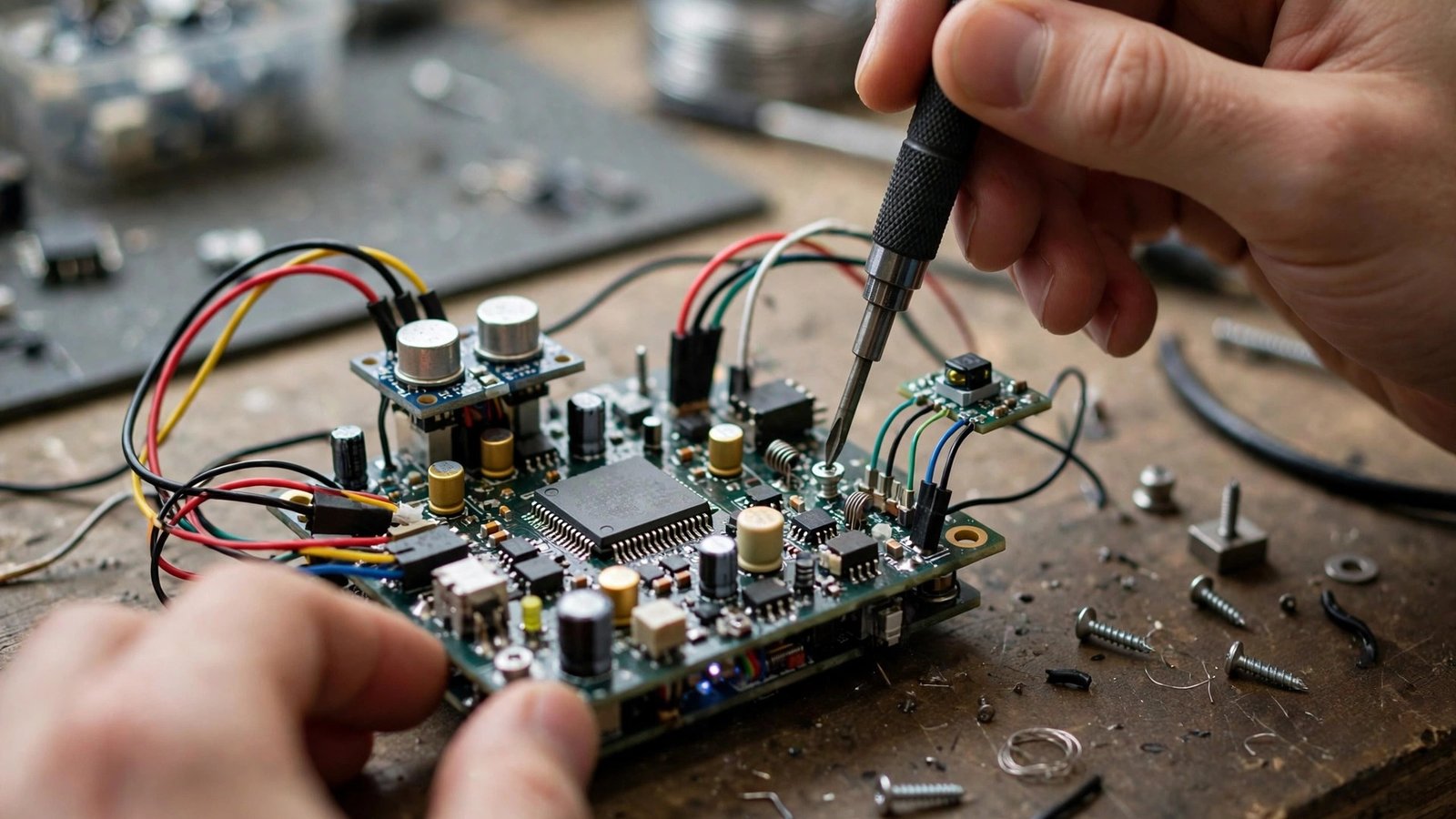
Computer engineering is the branch of engineering concerned with designing, building, and testing computer systems and their components. Where computer science focuses mainly on software and theory, and electrical engineering on circuits and power, computer engineering deliberately covers the boundary between them: processors, circuit boards, memory devices, networks, and the low-level software — firmware and operating systems — that makes the hardware useful.
The field’s main areas include:
- Computer hardware design — processors, graphics chips, memory systems, and circuit boards.
- Embedded systems — the dedicated computers inside vehicles, appliances, medical devices, and industrial machines.
- Firmware and systems software — the code that runs directly on hardware.
- Networks and communications hardware — routers, switches, and wireless systems.
- VLSI design — creating integrated circuits at very large scale, packing billions of transistors onto a chip.
- Robotics and control systems — machines that sense and act on the physical world.
If the distinction between hardware and code feels fuzzy, our explainer on what hardware and software are lays out the two halves computer engineers unite.
What Is a Computer Engineer?
A computer engineer is a professional trained in both electronic engineering and software design who creates computing technology — or integrates it into products and larger systems. Most hold a bachelor’s degree in computer engineering, or in electrical engineering or computer science with a hardware focus, typically from an accredited program.
Common job titles include hardware engineer, embedded systems engineer, firmware engineer, VLSI design engineer, and systems engineer. According to the U.S. Bureau of Labor Statistics, computer hardware engineers research, design, develop, and test computer systems and components such as processors, circuit boards, and memory devices — and the degree is the standard entry ticket for the field.
What separates computer engineers from neighboring roles is range: they can read a circuit schematic in the morning and debug the firmware running on that circuit in the afternoon.
What Computer Engineers Do Day to Day
Daily work varies by specialty, but typical computer engineering tasks include:
- Designing components and systems. Using CAD and simulation tools to model a processor, board, or embedded controller before anything is physically built.
- Writing low-level code. Developing firmware in languages like C and C++ that runs directly on microcontrollers and devices.
- Testing and validating prototypes. Checking that hardware meets speed, power, heat, and reliability targets — and that it works with current software.
- Integrating hardware and software. Making sure a new chip, board, or device cooperates with operating systems, drivers, and applications.
- Troubleshooting failures. Tracking down whether a bug lives in the silicon, the board, or the code.
- Collaborating across teams. Working with software developers, product managers, and manufacturers to bring a design to production.
Industries hiring computer engineers include consumer electronics, automotive, aerospace, telecommunications, healthcare technology, defense, and semiconductor manufacturing. Career planning resources like our roadmap on how to become a software engineer show a parallel path, and comparing the two helps students pick the right major.
Computer Engineering vs. Computer Science vs. Electrical Engineering
These three degrees overlap but aim at different work:
- Computer science centers on software, algorithms, and data — building applications and systems that run on existing hardware.
- Electrical engineering centers on circuits, signals, power, and electronics in general — a broader field of which computing is one part.
- Computer engineering centers on the computer itself: designing the hardware and the software closest to it, and making the two perform as one.
A useful rule: if the job is mostly about the machine, it leans computer engineering; mostly about programs, computer science; mostly about electricity and signals, electrical engineering. Students comparing programs can also browse the wider landscape in our guide to computer science fields.
Skills and Education You Need
Employers consistently look for:
- Programming — C and C++ above all, plus Python for testing and tooling; hardware description languages such as Verilog or VHDL for chip design.
- Digital logic and circuit fundamentals — the building blocks of every processor.
- Mathematics — calculus, linear algebra, discrete math, and probability.
- Problem-solving and lab skills — designing experiments, measuring results, and reasoning from data.
The standard path is a four-year bachelor’s degree, internships or co-op placements for hands-on experience, and continuous learning afterward, since chip and device technology changes quickly. Some roles — research positions, advanced chip architecture — prefer a master’s degree.
A Brief History of the Field
Computer engineering grew up alongside the computer itself. In the 1940s and 1950s, the people who built machines like ENIAC were electrical engineers by training, because no separate discipline existed. As transistors (1947) and then integrated circuits (late 1950s) shrank computers from rooms to desks, the work of designing them became specialized enough to need its own name.
The microprocessor — a complete CPU on a single chip, commercialized by Intel’s 4004 in 1971 — was the turning point. Suddenly the interesting problems were not just electrical but architectural: how instructions, memory, and input/output fit together, and how software should drive the hardware. Universities responded with dedicated computer engineering programs in the 1970s and 1980s, blending the EE and CS curricula rather than forcing students to choose.
Today the field keeps expanding at both extremes: at the tiny end, microcontrollers costing less than a dollar run appliances and sensors; at the huge end, engineers design warehouse-scale systems and custom AI accelerator chips that train the largest software models in existence.
Where Computer Engineers Are Making an Impact Now
- Electric and autonomous vehicles — cars now carry dozens of networked computers managing batteries, motors, sensors, and driver assistance; computer engineers design those control systems.
- Artificial intelligence hardware — GPUs and specialized accelerators that make modern AI practical are designed by computer engineers working at the boundary of architecture and algorithms.
- Medical devices — imaging systems, monitors, and implantable devices where reliability and low-level software correctness are literally life-critical.
- The Internet of Things — billions of small, connected, battery-powered devices, each a compact exercise in hardware-software trade-offs.
- Robotics and drones — systems that must sense, decide, and act in the physical world in real time, combining control theory, embedded computing, and mechanical constraints.
- Communications infrastructure — the routers, base stations, and satellites behind 5G and global connectivity.
The common thread across all of these is integration: success depends on understanding the whole system, not one layer of it — exactly the perspective the degree is designed to teach.
What Studying Computer Engineering Looks Like
A typical bachelor’s program builds in layers. The first two years lay foundations: calculus and physics, introductory programming, digital logic, and circuit analysis, alongside general education. The final two years go deeper and more specialized:
- Core courses — computer architecture (how processors are organized), operating systems, embedded systems, signals and systems, electronics, and data structures.
- Laboratory work — building and measuring real circuits, programming microcontrollers, and testing designs against specifications. Labs are where the field’s hands-on identity is formed.
- Electives and specialization — students tilt toward interests like VLSI design, robotics, networks, or computer vision.
- Capstone project — a senior design project, usually in a team, that takes a system from requirements to a working prototype: the closest rehearsal for professional practice.
Accreditation matters: in the US, employers and graduate schools look for ABET-accredited programs, which certify that the curriculum meets the profession’s standards. Beyond the degree, internships and personal projects — a self-built embedded device, an FPGA project, open-source firmware contributions — are what separate strong candidates, because they prove the graduate can integrate skills, not just pass exams on them one at a time.
Frequently Asked Questions
Is computer engineering harder than computer science?
It is different rather than simply harder. Computer engineering adds electrical engineering coursework — circuits, signals, physics — on top of programming, which students who prefer pure software may find more demanding. Students who enjoy hands-on hardware usually find it more engaging.
Do computer engineers write code?
Yes, regularly — but usually code that is close to the hardware: firmware, drivers, embedded software, and testing tools, most often in C or C++. It is less commonly web or business application development.
What jobs can you get with a computer engineering degree?
Hardware engineer, embedded systems engineer, firmware engineer, chip (VLSI) designer, network hardware engineer, robotics engineer, and systems engineer are common titles, across industries from smartphones to aerospace.
How much do computer engineers earn?
Pay is strong relative to most fields; the U.S. Bureau of Labor Statistics reports median annual pay for computer hardware engineers in the six-figure range in recent data. Exact figures vary by year, specialty, and region, so check the BLS page linked above for current numbers.
Is computer engineering a good career for the future?
Demand is steady rather than explosive for hardware roles, and it is reinforced by growth in embedded systems, electric vehicles, robotics, and AI hardware — all areas that need people fluent in both hardware and software.
Conclusion
Computer engineering is the discipline that builds the machines the rest of computing runs on. It blends circuits and code, theory and lab work, and it leads to careers designing the processors, devices, and embedded systems inside nearly every modern product. If you like understanding technology at the level of how it physically works — and you enjoy programming too — it is one of the most versatile engineering degrees you can choose.
